Showing posts with label opiates. Show all posts

Friday, September 29, 2023

Opiate outrage...


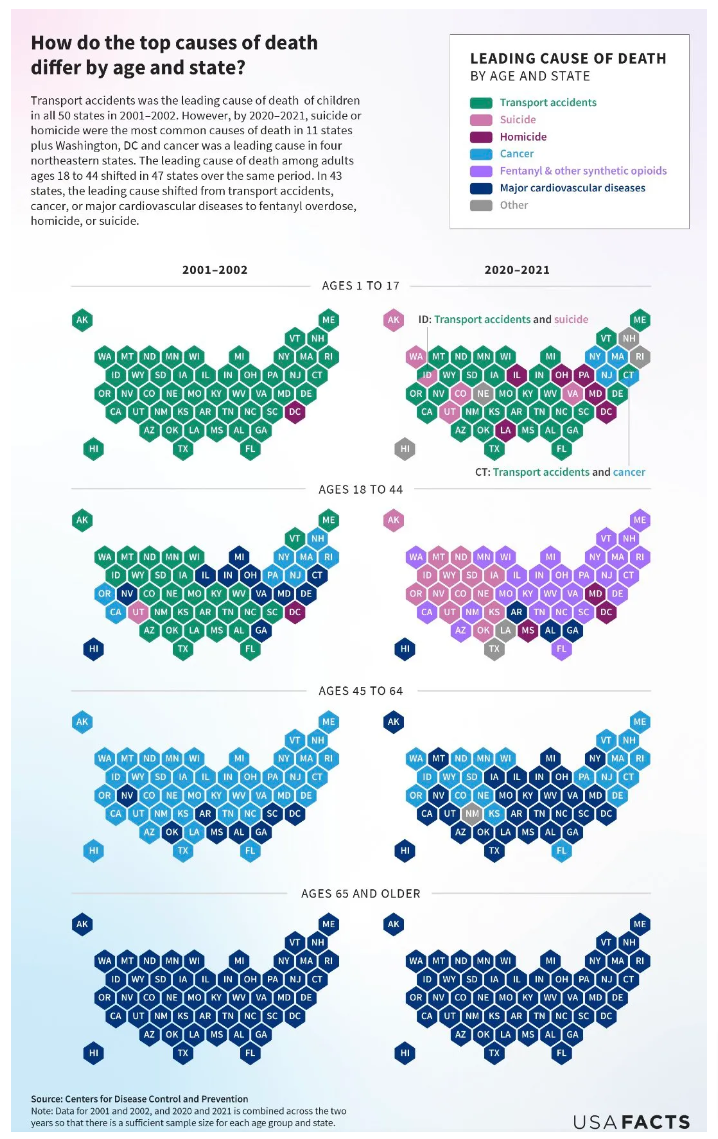
Well, the image below tells it's own story, and it's a horror story. In only two decades look how the leading cause of death has changed in the USA (by age and state). At the beginning of the century only the cesspool of a Federal capitol had anything other than the 'innocent' traffic accident deaths for ages UP TO 17; now suicide, homicide ad cancer (WTF!...surely not you know what?) is gaining ground. That is horrific. Then look at 18-44 year olds, oh my God! Suicide and substance abuse/addiction (presumably leading to many of the suicides!) 

Major massive epidemic that seems far worse than anyone imagines. And guess what? this week Suella Braverman (UK Home Secretary) admitted it was 'inevitable' the same would come to Britain. If you actually get to live more than 45 years then cause of death becomes more 'settled' and predictable.  


Hat-tip: Naked Emperor's Must reads today.

Opiate outrage...


Well, the image below tells it's own story, and it's a horror story. In only two decades look how the leading cause of death has changed in the USA (by age and state). At the beginning of the century only the cesspool of a Federal capitol had anything other than the 'innocent' traffic accident deaths for ages UP TO 17; now suicide, homicide ad cancer (WTF!...surely not you know what?) is gaining ground. That is horrific. Then look at 18-44 year olds, oh my God! Suicide and substance abuse/addiction (presumably leading to many of the suicides!) 

Major massive epidemic that seems far worse than anyone imagines. And guess what? this week Suella Braverman (UK Home Secretary) admitted it was 'inevitable' the same would come to Britain. If you actually get to live more than 45 years then cause of death becomes more 'settled' and predictable.  
Hat-tip: Naked Emperor's Must reads today.

Saturday, June 10, 2023

Older opium outlook...


Image from RFI (France)
Interesting insights into the Afghanistan government's (AKA The Taliban) successful ban on opium production. William Byrd [Link to article] writing at The United States Institute of Peace [About] says "The ban is not a counter-narcotics victory and will have negative economic and humanitarian consequences, potentially leading to a refugee crisis.

This isn't the first time; the previous successful ban was in 2000/01 (and we all know what happened just afterwards and Helmand is 'by far Afghanistan's largest opium-producing province'...complete coincidence though). 

Banning opium production sounds like it is a noble cause right, especially as "Unlike the Taliban's previous opium ban, the current ban encompasses trade and processing of opiates, not just poppy cultivation." BUT the cultivated and harvest bumper crop from last year is not only exempted from destruction but also the trade of it can carry on. That said it does mean they are aware that bankrupting much of the rural population isn't a good thing either, so again, they've learnt from last time! 

Also, the noble cause is further tainted by the possibility that it is an economic ruse to restrict supply to allow the market price to rise and they can cash in on their large stock (super simplified and not wholly accurate, as discussed in links below). 

The article sheds more light on the whole situation and is definitely worth a read, with many references and info from David Mansfield reports at Alcis, ("Truly Unprecedented") and the Chapter 'Repositioning a Pariah Regime' from Mansfield's book A State Built on Sand is excellent [PDF

The war/s, COVID crises and intermittently closed borders cause -and have caused- much hardship over the years (you don't say) and 'although numerous eradication programmes have been underway for several years' (from picture link), Afghanistan has continued to be the world's main producer of opium (over 80% of total), so any ban is very likely to be temporary...ahem.
Older opium outlook...


Image from RFI (France)
Interesting insights into the Afghanistan government's (AKA The Taliban) successful ban on opium production. William Byrd [Link to article] writing at The United States Institute of Peace [About] says "The ban is not a counter-narcotics victory and will have negative economic and humanitarian consequences, potentially leading to a refugee crisis.

This isn't the first time; the previous successful ban was in 2000/01 (and we all know what happened just afterwards and Helmand is 'by far Afghanistan's largest opium-producing province'...complete coincidence though). 

Banning opium production sounds like it is a noble cause right, especially as "Unlike the Taliban's previous opium ban, the current ban encompasses trade and processing of opiates, not just poppy cultivation." BUT the cultivated and harvest bumper crop from last year is not only exempted from destruction but also the trade of it can carry on. That said it does mean they are aware that bankrupting much of the rural population isn't a good thing either, so again, they've learnt from last time! 

Also, the noble cause is further tainted by the possibility that it is an economic ruse to restrict supply to allow the market price to rise and they can cash in on their large stock (super simplified and not wholly accurate, as discussed in links below). 

The article sheds more light on the whole situation and is definitely worth a read, with many references and info from David Mansfield reports at Alcis, ("Truly Unprecedented") and the Chapter 'Repositioning a Pariah Regime' from Mansfield's book A State Built on Sand is excellent [PDF

The war/s, COVID crises and intermittently closed borders cause -and have caused- much hardship over the years (you don't say) and 'although numerous eradication programmes have been underway for several years' (from picture link), Afghanistan has continued to be the world's main producer of opium (over 80% of total), so any ban is very likely to be temporary...ahem.

Monday, July 20, 2020

Observing opioid overdosing...


Iman Ghosh's article on opioids last week at The Visual Capitalist shows "The Spiraling Opioid Epidemic in America" certainly isn't getting any better. The graphic and info are actually terrifying. "As per the medical and legal standard, opioids are often compared to morphine. To that end, heroin is 2-5x stronger—while fentanyl is 50-100x more potent."  And worse is here/on the way:


"Another drug rearing its head on the streets is carfentanil. Formerly developed as ‘elephant tranquilizer’, this synthetic opioid is similar in appearance to other illicit drugs such as heroin, making it indistinguishable when mixed in. However, there’s one big problem—carfentanil is 100x more potent than fentanyl itself."

The data is from the UN World Drug Report 2020 [Executive Summary] and the image left (click to enlarge) - showing a few surprises in the Top Ten countries for drug related death - is clipped from Iman's post.


A further graphic on "Deaths by drug overdose (unintentional) in the U.S. from 1950 to 2017 (per 100,000 population)" [Visual Capitalist link] shows how the rate has ballooned this century and how it is accelerating. From 1950 to 1990 it bobbled up and down below 3%, in 2017 it had reached 20%. The biggest leap was a mammoth 40% from 2014-2016 (13.1% to 18.2%).


Hat-tip: Zero Hedge


Previous reading:  Options on opiates III . Or if you prefer not so serious but interesting stuff: Options on opiates and Options on opiates II, that second one: "chloroform, cannabis, alcohol and morphine in a single cough medicine! Then cocaine to cure the addiction!"

Observing opioid overdosing...


Iman Ghosh's article on opioids last week at The Visual Capitalist shows "The Spiraling Opioid Epidemic in America" certainly isn't getting any better. The graphic and info are actually terrifying. "As per the medical and legal standard, opioids are often compared to morphine. To that end, heroin is 2-5x stronger—while fentanyl is 50-100x more potent."  And worse is here/on the way:
"Another drug rearing its head on the streets is carfentanil. Formerly developed as ‘elephant tranquilizer’, this synthetic opioid is similar in appearance to other illicit drugs such as heroin, making it indistinguishable when mixed in. However, there’s one big problem—carfentanil is 100x more potent than fentanyl itself."
The data is from the UN World Drug Report 2020 [Executive Summary] and the image left (click to enlarge) - showing a few surprises in the Top Ten countries for drug related death - is clipped from Iman's post.

A further graphic on "Deaths by drug overdose (unintentional) in the U.S. from 1950 to 2017 (per 100,000 population)" [Visual Capitalist link] shows how the rate has ballooned this century and how it is accelerating. From 1950 to 1990 it bobbled up and down below 3%, in 2017 it had reached 20%. The biggest leap was a mammoth 40% from 2014-2016 (13.1% to 18.2%).

Hat-tip: Zero Hedge

Previous reading:  Options on opiates III . Or if you prefer not so serious but interesting stuff: Options on opiates and Options on opiates II, that second one: "chloroform, cannabis, alcohol and morphine in a single cough medicine! Then cocaine to cure the addiction!"

Friday, June 01, 2018

Opiate overdose obduracy...


Or Options on opiates III if you follow this blog or like reading interesting stuff! (Options on opiates and Options on opiates II; I like that second one: chloroform, cannabis, alcohol and morphine in a single cough medicine! Then cocaine to cure the addiction!)...


Anyhoo...

I am currently reading an enjoyable fiction novel that has the plot of opiate addiction. The author mentions that this is nothing new and is really a repeat of what happened in the period up to WWI. Although I knew a bit about it - re laudanum luvvies - it chimed exactly with an article I was reading in the NYT (yes, yes, I know): "The late-19th-century opiate epidemic was nearly identical to the one now spreading across the United States", from Clinton Lawson's "America’s 150-Year Opioid Epidemic"..."In the case of the opioid epidemic, history is literally repeating itself.". the article very maturely points out that the main problem is to find a way to take the appropriate steps to both 'confront the powerful interests that drive' the over-prescribing of opiate painkillers and avoid over-criminalising the 'victims': most addicts aren't needle using zombie-looking dropouts in a dirty 'trainspotting toilet' backdrop. And some of these [CBS] "prescription painkillers are about 50 times more potent than heroin and up to 100 times more potent than morphine."


The Council on Foreign Relations has a great background on the issue and although the US Opiate Epidemic is clearly the worst, they are certainly not alone (scroll down to "How are other countries dealing with opioid addiction" HERE). In the UK too, opioid abuse is growing. "Britain already has Europe’s highest proportion of heroin addicts, and last year, drug-related deaths hit a record high in England and Wales" and as previously mentioned, it isn't always the "classic". The image above is from the same article, look closely: click to enlarge.


More info: NIH/NIDA, where it also tells the sorry tale that from July 2016 through September 2017 opioid overdoses increased 30 percent in 45 states; in the Midwest region where a large number of my family (not immediate) live, the increase was 70 percent.

Opiate overdose obduracy...


Or Options on opiates III if you follow this blog or like reading interesting stuff! (Options on opiates and Options on opiates II; I like that second one: chloroform, cannabis, alcohol and morphine in a single cough medicine! Then cocaine to cure the addiction!)...

Anyhoo... I am currently reading an enjoyable fiction novel that has the plot of opiate addiction. The author mentions that this is nothing new and is really a repeat of what happened in the period up to WWI. Although I knew a bit about it - re laudanum luvvies - it chimed exactly with an article I was reading in the NYT (yes, yes, I know): "The late-19th-century opiate epidemic was nearly identical to the one now spreading across the United States", from Clinton Lawson's "America’s 150-Year Opioid Epidemic"..."In the case of the opioid epidemic, history is literally repeating itself.". the article very maturely points out that the main problem is to find a way to take the appropriate steps to both 'confront the powerful interests that drive' the over-prescribing of opiate painkillers and avoid over-criminalising the 'victims': most addicts aren't needle using zombie-looking dropouts in a dirty 'trainspotting toilet' backdrop. And some of these [CBS] "prescription painkillers are about 50 times more potent than heroin and up to 100 times more potent than morphine."

The Council on Foreign Relations has a great background on the issue and although the US Opiate Epidemic is clearly the worst, they are certainly not alone (scroll down to "How are other countries dealing with opioid addiction" HERE). In the UK too, opioid abuse is growing. "Britain already has Europe’s highest proportion of heroin addicts, and last year, drug-related deaths hit a record high in England and Wales" and as previously mentioned, it isn't always the "classic". The image above is from the same article, look closely: click to enlarge.

More info: NIH/NIDA, where it also tells the sorry tale that from July 2016 through September 2017 opioid overdoses increased 30 percent in 45 states; in the Midwest region where a large number of my family (not immediate) live, the increase was 70 percent.

Saturday, July 15, 2006

Options on opiates...


I want to clean my teeth again mummy...although not literally opiates, (although heroin does get a mention later) this is the South American equivalent - as in drug and addiction equivalent, not in effects as they are widely different.


Cocaine is extracted from the plant called Erythroxylon coca, and other species containing lesser quantities of ‘cocaine’, and is a local anesthetic and central nervous system stimulant. It can be taken by chewing on coca leaves, smoked, inhaled ("snorted") or injected; E.coca is to cocaine as poppies/opium are to heroin/morphine (morphine is the active ingredient in opium).
By the turn of the twentieth century, the addictive properties of cocaine had become clear to many; in 1903, the American Journal of Pharmacy stressed that most cocaine abusers were “bohemians, gamblers, high- and low-class prostitutes, night porters, bell boys, burglars, racketeers, pimps, and casual laborers.”….nice. It was finally made illegal in 1914 but the law incorrectly referred to cocaine as a narcotic, and this misclassification still exists today: as stated above, cocaine is a stimulant, not a narcotic: a narcotic is an addictive drug that reduces pain and induces sleep (and may alter mood or behavior) - such state is narcosis - derived from the Greek word narkotikos.

coca leavesEarly Spanish explorers noticed how the native people of South America were able to fight off fatigue by chewing on coca leaves. This led eventually to a medical account of the coca plant being published in 1569 and almost 3 centuries later , in 1860 - after several failed attempts mainly due to lack of chemical technologies - Albert Neiman, a PhD student at Göttingen Uni in Germany, isolated cocaine from the coca leaf and described the anesthetic action of the drug; his dissertation titled Über eine neue organische Base in den Cocablättern (On a New Organic Base in the Coca Leaves), is now in the British Library…he got his PhD too!

Afterwards, various medicinal wines became available and later, in the USA, John Pemberton developed a non-alcoholic version, Coca Cola, a drink that contained cocaine and caffeine; no coke in ‘Coke’ since 1906.

In 1879 cocaine began to be used to treat morphine addiction and was introduced into clinical use as a local anaesthetic in Germany in 1884, about the same time as Sigmund Freud published his work Über Coca, in which he wrote that cocaine causes:

...exhilaration and lasting euphoria, which in no way differs from the normal euphoria of the healthy person...You perceive an increase of self-control and possess more vitality and capacity for work....In other words, you are simply normal, and it is soon hard to believe you are under the influence of any drug....Long intensive physical work is performed without any fatigue...This result is enjoyed without any of the unpleasant after-effects that follow exhilaration brought about by alcohol....Absolutely no craving for the further use of cocaine appears after the first, or even after repeated taking of the drug...

He recommended cocaine for a variety of illnesses and for alcohol and morphine addictions with the conclusion that many of his patients went on to become addicted to cocaine....a Freudian slip!

In 1909, the great explorer Ernest Shackleton and his teams in Antarctica took cocaine tablets, the brand was “Forced March”, clearly marketed to fight fatigue; as did Captain Scott a year later on his ill-fated journey to the South Pole


The following, which I read and saved was reported in The Observer last year; not really sure why I chose to post it now, especially with what Augustus has been telling us lately - perhaps it's the surroundings I find myself in. Anyway, the article:

"This is when your lungs get fucked,' the cook splutters as he unscrews the top of a plastic bottle and carefully pours hydrochloric acid into the brown liquid. Gun tucked in his waistband, he reacts nervously to any sound, even the chickens rooting through the undergrowth. We have been told to run if any shooting starts but are not sure where to. At the bottom of the bowl, the acid and the brown liquid start to turn white. A minute in the microwave, and we have a kilo of cocaine."

"We are in the depths of the Peruvian jungle watching coca leaves being converted into one of the most potent commodities on the planet. Using a few leaves, lime, alcohol and acid, cocaine costs about £500 a kilo to make. By the time it reaches the streets of Soho, supplemented with anything from aspirin to powdered glass, it weighs two kilos and is worth around £35,000, a profit of more than £34,000. "

Read the rest here: The White Stuff, Sunday January 9, 2005 The Observer. "Celebrated documentary-maker Angus Macqueen spent 18 months on the cocaine trail across Latin America from the dirt-poor valleys of Peru to the shanty towns of Rio. Here he recalls the journey that revolutionised his views and explains why he believes 'the dandruff of the Andes' should be sold in Boots."


The final few paragraphs:

"Just as with Colombia's civil war, all the social problems cannot be laid at the door of cocaine. But the white stuff feeds huge amounts of criminal money into the conflict. The picture, though not on the same scale, is much the same on British and American inner-city streets.

When we read about the rise of gun crime, the phrase 'drugs-related' is rarely far away as rivals battle for a piece of that £34,000-per-kilo profit. This journey has left me thinking the politically unthinkable. With an election looming, the Blair government has made the war on drugs a populist law-and-order priority, once again conflating the taking of drugs with the crime and violence that surrounds them. But it is the war itself that is the problem. The politicians rightly warn that demand will go up if it is legalised. It is not good but not the nightmare they summon up: neither cocaine nor heroin is a cancer. In quantities it destroys your nose and is bad for your brain, but it very rarely kills - unlike that other addictive plant we can use legally: tobacco. Nor is it a direct cause of violence, like alcohol. "

"Let's be honest. People try drugs, whether in the form of alcohol or pills, because they are fun. Tens of thousands of UK citizens regularly consume cocaine; hundreds of thousands more use other illegal drugs, completely discrediting the law. In his book Cocaine, Dominic Streatfield quotes the monetarist Milton Friedman: 'I do not think you can eradicate demand. The lesson we have failed to learn is that prohibition never works. It makes things worse not better.'
Streatfield quotes the extraordinary statistics involved in fighting cocaine and drugs. Here are a couple: over the past 15 years, the US has spent £150 billion trying to stop its people getting hold of drugs. In Britain and the US almost 20 per cent of the prison population is inside for drugs offences. So what is left? We can muddle on or we can legalise cocaine - and indeed all drugs. "


"This won't solve the social ills of poverty or inequality here or in Latin America but it would remove vast sums of money from the criminal world. We should allow the farmers to grow coca and sell it for decent prices direct to government-controlled factories which can produce a high-quality product. And then it should be sold over the counter from registered chemists such as Boots to anyone over 18 at a reasonable, taxed price that does not encourage a black market. At least then we will know it is pure. Then we must attack demand by using some of the millions saved to invest in education drives that are honest. Look how effective a generation of anti-smoking education has been in bringing the public behind stringent restrictions on smoking in public, but not an outright ban."
"Yes, more people will try these drugs and there will be tragedies. But 30 years of the war on drugs have achieved almost nothing except to make a few people fantastically rich, to arm our inner cities, to criminalise a generation of users, and to leave tens of thousands of Latin Americans dead. As our cocaine maker in Peru happily told us, 'People want our cocaine because it is good and, for a while at least, makes them happy.' "

S.O. (as usual, all the pictures are links)

Options on opiates...

I want to clean my teeth again mummy...although not literally opiates, (although heroin does get a mention later) this is the South American equivalent - as in drug and addiction equivalent, not in effects as they are widely different.

Cocaine is extracted from the plant called Erythroxylon coca, and other species containing lesser quantities of ‘cocaine’, and is a local anesthetic and central nervous system stimulant. It can be taken by chewing on coca leaves, smoked, inhaled ("snorted") or injected; E.coca is to cocaine as poppies/opium are to heroin/morphine (morphine is the active ingredient in opium).
By the turn of the twentieth century, the addictive properties of cocaine had become clear to many; in 1903, the American Journal of Pharmacy stressed that most cocaine abusers were “bohemians, gamblers, high- and low-class prostitutes, night porters, bell boys, burglars, racketeers, pimps, and casual laborers.”….nice. It was finally made illegal in 1914 but the law incorrectly referred to cocaine as a narcotic, and this misclassification still exists today: as stated above, cocaine is a stimulant, not a narcotic: a narcotic is an addictive drug that reduces pain and induces sleep (and may alter mood or behavior) - such state is narcosis - derived from the Greek word narkotikos.

coca leavesEarly Spanish explorers noticed how the native people of South America were able to fight off fatigue by chewing on coca leaves. This led eventually to a medical account of the coca plant being published in 1569 and almost 3 centuries later , in 1860 - after several failed attempts mainly due to lack of chemical technologies - Albert Neiman, a PhD student at Göttingen Uni in Germany, isolated cocaine from the coca leaf and described the anesthetic action of the drug; his dissertation titled Über eine neue organische Base in den Cocablättern (On a New Organic Base in the Coca Leaves), is now in the British Library…he got his PhD too!

Afterwards, various medicinal wines became available and later, in the USA, John Pemberton developed a non-alcoholic version, Coca Cola, a drink that contained cocaine and caffeine; no coke in ‘Coke’ since 1906.

In 1879 cocaine began to be used to treat morphine addiction and was introduced into clinical use as a local anaesthetic in Germany in 1884, about the same time as Sigmund Freud published his work Über Coca, in which he wrote that cocaine causes:

...exhilaration and lasting euphoria, which in no way differs from the normal euphoria of the healthy person...You perceive an increase of self-control and possess more vitality and capacity for work....In other words, you are simply normal, and it is soon hard to believe you are under the influence of any drug....Long intensive physical work is performed without any fatigue...This result is enjoyed without any of the unpleasant after-effects that follow exhilaration brought about by alcohol....Absolutely no craving for the further use of cocaine appears after the first, or even after repeated taking of the drug...

He recommended cocaine for a variety of illnesses and for alcohol and morphine addictions with the conclusion that many of his patients went on to become addicted to cocaine....a Freudian slip!

In 1909, the great explorer Ernest Shackleton and his teams in Antarctica took cocaine tablets, the brand was “Forced March”, clearly marketed to fight fatigue; as did Captain Scott a year later on his ill-fated journey to the South Pole


The following, which I read and saved was reported in The Observer last year; not really sure why I chose to post it now, especially with what Augustus has been telling us lately - perhaps it's the surroundings I find myself in. Anyway, the article:

"This is when your lungs get fucked,' the cook splutters as he unscrews the top of a plastic bottle and carefully pours hydrochloric acid into the brown liquid. Gun tucked in his waistband, he reacts nervously to any sound, even the chickens rooting through the undergrowth. We have been told to run if any shooting starts but are not sure where to. At the bottom of the bowl, the acid and the brown liquid start to turn white. A minute in the microwave, and we have a kilo of cocaine."

"We are in the depths of the Peruvian jungle watching coca leaves being converted into one of the most potent commodities on the planet. Using a few leaves, lime, alcohol and acid, cocaine costs about £500 a kilo to make. By the time it reaches the streets of Soho, supplemented with anything from aspirin to powdered glass, it weighs two kilos and is worth around £35,000, a profit of more than £34,000. "

Read the rest here: The White Stuff, Sunday January 9, 2005 The Observer. "Celebrated documentary-maker Angus Macqueen spent 18 months on the cocaine trail across Latin America from the dirt-poor valleys of Peru to the shanty towns of Rio. Here he recalls the journey that revolutionised his views and explains why he believes 'the dandruff of the Andes' should be sold in Boots."

The final few paragraphs:
"Just as with Colombia's civil war, all the social problems cannot be laid at the door of cocaine. But the white stuff feeds huge amounts of criminal money into the conflict. The picture, though not on the same scale, is much the same on British and American inner-city streets.
When we read about the rise of gun crime, the phrase 'drugs-related' is rarely far away as rivals battle for a piece of that £34,000-per-kilo profit. This journey has left me thinking the politically unthinkable. With an election looming, the Blair government has made the war on drugs a populist law-and-order priority, once again conflating the taking of drugs with the crime and violence that surrounds them. But it is the war itself that is the problem. The politicians rightly warn that demand will go up if it is legalised. It is not good but not the nightmare they summon up: neither cocaine nor heroin is a cancer. In quantities it destroys your nose and is bad for your brain, but it very rarely kills - unlike that other addictive plant we can use legally: tobacco. Nor is it a direct cause of violence, like alcohol. "
"Let's be honest. People try drugs, whether in the form of alcohol or pills, because they are fun. Tens of thousands of UK citizens regularly consume cocaine; hundreds of thousands more use other illegal drugs, completely discrediting the law. In his book Cocaine, Dominic Streatfield quotes the monetarist Milton Friedman: 'I do not think you can eradicate demand. The lesson we have failed to learn is that prohibition never works. It makes things worse not better.'
Streatfield quotes the extraordinary statistics involved in fighting cocaine and drugs. Here are a couple: over the past 15 years, the US has spent £150 billion trying to stop its people getting hold of drugs. In Britain and the US almost 20 per cent of the prison population is inside for drugs offences. So what is left? We can muddle on or we can legalise cocaine - and indeed all drugs. "

"This won't solve the social ills of poverty or inequality here or in Latin America but it would remove vast sums of money from the criminal world. We should allow the farmers to grow coca and sell it for decent prices direct to government-controlled factories which can produce a high-quality product. And then it should be sold over the counter from registered chemists such as Boots to anyone over 18 at a reasonable, taxed price that does not encourage a black market. At least then we will know it is pure. Then we must attack demand by using some of the millions saved to invest in education drives that are honest. Look how effective a generation of anti-smoking education has been in bringing the public behind stringent restrictions on smoking in public, but not an outright ban."
"Yes, more people will try these drugs and there will be tragedies. But 30 years of the war on drugs have achieved almost nothing except to make a few people fantastically rich, to arm our inner cities, to criminalise a generation of users, and to leave tens of thousands of Latin Americans dead. As our cocaine maker in Peru happily told us, 'People want our cocaine because it is good and, for a while at least, makes them happy.' "
S.O. (as usual, all the pictures are links)